
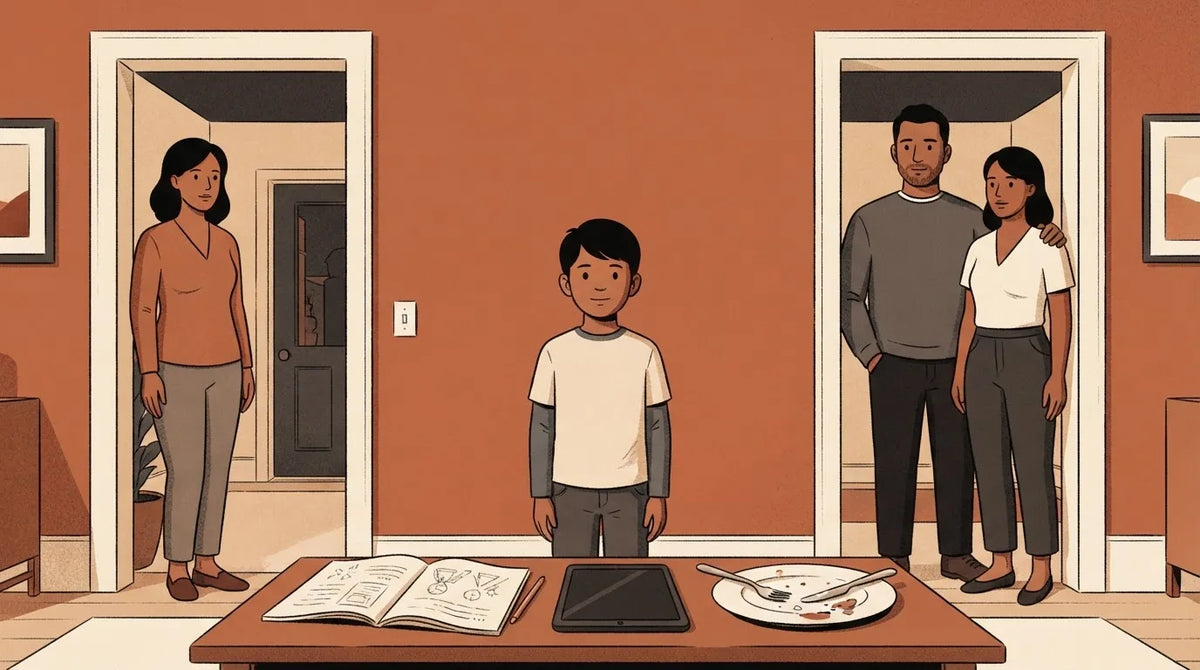
In brief: A mother writes to a psychological advice column describing that after her ex-husband found a new partner, the rules in the father's household changed, according to her son. Her son tells her he doesn't know whom to obey, is afraid of making a mistake, and asks whether his father's partner also makes decisions about him. The text does not include the psychologist's response.
- According to the mother, after the divorce, the parents were able to agree on school, extracurricular activities, and everyday responsibilities.
- The mother states that her ex-husband's partner interferes with homework, computer time, meals, and watching cartoons.
- The mother describes her approach as explaining the reasons behind restrictions and giving her son appropriate room to make decisions.
- According to the son's reported words, he doesn't know whom to obey, is afraid of making a mistake, and asks whether his father's partner also makes decisions about him.
In shared custody, my ex-husband and I gradually found a way to agree on our son's school, extracurricular activities, and daily responsibilities. He is now eight years old, and in my view, things started to get complicated after his father found a new partner. I don't want this to sound like I begrudge him the new relationship. What worries me more is how, according to my son, the rules in his father's household have changed and how insecure he feels within them.
The mother writes to a psychological advice column describing that after her ex-husband found a partner, the rules in the father's household changed, according to her son. Her son tells her he doesn't know whom to obey, is afraid of making a mistake, and asks whether his father's partner also makes decisions about him. The text does not include the psychologist's response.
This question is not only about the fact that two parents may have different habits in their households. My description also includes a new person who, according to the son's words, has started setting the rules. It is precisely this change and my son's uncertainty that I am trying to put into words.
How we agreed on rules after the divorce
My ex-husband and I have an eight-year-old son in joint custody. We divorced three years ago. Our relationship wasn't always easy, but over time we set up rules that worked quite well for us.

We were able to agree on school, extracurricular activities, and everyday responsibilities. That doesn't mean we thought alike about everything or that every matter went smoothly. From my perspective, though, we found a way to reach agreements on important daily topics and ensure they were clear to both parents.
That's why I notice the change precisely in contrast to what we had managed before. I'm not describing the post-divorce period as completely problem-free. I'm saying that over time we created rules regarding school, activities, and daily duties, and that in my perception they worked.
What I think changed after the new partner came along
In my view, the situation started to get complicated after my ex-husband found a girlfriend. I'm glad he has someone by his side who makes him happy. I don't want to question his new relationship or portray it as a problem in itself. My concern is that his partner, based on what I describe, began to heavily involve herself in raising our son.
When our son is at his father's place, according to what he tells me, his partner checks his homework, decides how much time he can spend on the computer, and determines what he may or may not eat. These are specific situations that, according to our son, take place in his father's household. This is not an independently verified account, nor is it a statement from his father or partner: in this text, I'm capturing my own experience and what my son tells me.
The distinction matters to me. I can talk about what I heard from my son and what worries me, but I can't explain on behalf of others how they perceive these situations. Their viewpoint on the question I sent to the advice column is not included.
Homework, computer, food, and fairy tales
The rules my son talks about concern everyday activities at home. He mentions homework, computer time, and food. These are decisions he encounters during his stay with his father, and according to him, his father's partner makes these decisions.
Recently, my son told me she forbade him from watching a fairy tale. As a reason, she reportedly told him he was no longer a little child. Another time, according to him, she forced him to finish his entire meal even though he wasn't hungry. I present these two examples as my son conveyed them to me; I don't add my own interpretation of her motives.
The examples are different, but in both, the question arises of who, at that moment, determines what my son may or must do. With the fairy tale, it's about a prohibition and its justification; with the food, it's about a demand to finish the portion despite my son saying he wasn't hungry. I can't infer from this how others would describe the situation. For me, these events are significant mainly because my son associates them with the rules in his father's household.
Each household has slightly different rules
At home, I approach rules differently. When I forbid something to my son, I try to explain the reason. At the same time, I give him reasonable room to make decisions. This is how I describe my own approach, not rules that I think should automatically apply in the other household as well.
In my perception, my ex-husband was always more lenient in some matters. So I'm not saying that my son's father and I had the same approach. Different rules between our households existed before; the change I describe in my question relates to the fact that, according to my son, he perceives his father's partner as stricter than both parents.
That's why my question isn't just about comparing two parenting styles. I'm also unsettled by the role in upbringing of a person who, according to my son, has started setting the rules in his father's household. I'm not claiming I know the answer or that I know how his father and his partner understand this role. I'm describing what my son tells me and what concerns it raises in me.
Son doesn't know whom to obey
My son has told me several times that he doesn't know whom he should obey. He also says he's afraid of doing something wrong. I know these words secondhand, as he told them to me; I don't present them as an independent assessment of his feelings or as an expression of other family members.

According to what he tells me, his uncertainty concerns what he is allowed to do and whose instructions he should follow. In one household he encounters rules that I describe as mine, in the other rules that, in his view, are set by his father's partner. My son tells me he doesn't know how to make sense of it all and that he's afraid of making a mistake. I can't fill in for him what exactly he thinks at any given moment; I can only convey his words.
Most recently, he asked me whether this woman now gets to decide about him too. That question stayed with me because it ties into his repeated statements about whom he should obey and what happens if he does something wrong. At the same time, it doesn't provide an answer to what role his father's partner plays or who makes decisions about my son. It's a question my son asked me, and now I'm asking it too: How are we supposed to set healthy boundaries when his father's new partner has become involved in parenting?
The text is based on a mother's question published in the psychological advice column of Denník N. It is exclusive content for Denník N subscribers. The provided text contains the parent's question, not a psychologist's answer, and does not capture the stance of the ex-husband or his partner.
What the text says - and what it doesn't
Does the text include a psychologist's answer?
No. It captures the mother's question to the advice column and her description of the situation. The expert's answer is not included in the provided text, so it cannot be used as professional advice or a ready-made guide for resolving a similar situation.
Whose perspective does this story capture?
The story captures the mother's perspective and the son's statements as conveyed by the mother. The text does not include the father's or his partner's stance. When it talks about rules, a banned fairy tale, food, or the son's uncertainty, it is the mother's description and the son's secondhand words, not independently confirmed findings.
Key Takeaways
- According to the mother, after the divorce the parents were able to agree on school, extracurricular activities, and everyday responsibilities.
- The mother states that her ex-husband's partner interferes with homework, computer time, meals, and watching cartoons.
- The mother describes her approach as explaining the reasons behind rules and giving her child appropriate room to make decisions.
- According to relayed accounts, the son doesn't know whom to obey, is afraid of making a mistake, and asks whether his father's partner gets to decide things about him.


