
In short: Choose a board game based on the number of players, the age recommendation, the time you have available, and the mood of the group. Wavelength is great for conversation and guessing together, Codenames for team-based one-word clues, Scrabble for building words, and CATAN for longer strategic play. Before choosing, also check the limitations, such as the number of players or the age.
- First compare the number of players with the game's limit: Wavelength handles 2-12 or more, Scrabble 2-4, and the base CATAN 3-4.
- If time is short, consider Codenames with an estimated length of about 15 minutes; according to the source, CATAN requires 60-90 minutes.
- Choose according to mood: conversation and guessing with Wavelength, team clues with Codenames, word building with Scrabble, and trading with CATAN.
- With Scrabble, keep in mind the age of 8 and up, the 2-4 player limit, the estimated 40 minutes, and the risk of choking on small pieces.
A good board game doesn't need complicated rules. What matters is that players quickly find their way around them, make meaningful decisions during the game, and are happy to come back to it. So when choosing a board game for the family, start with who will be playing and how much time you have; only then work out whether you're more drawn to competition, conversation, word guessing, or strategy. You can also find an overview of games and their features in the guide to board games for family evenings.
Choose a board game based on the number of players, the age recommendation, the time you have available, and the mood of the group. Wavelength is great for conversation and guessing together, Codenames for team-based one-word clues, Scrabble for building words, and CATAN for longer strategic play. Before choosing, also check the limitations, such as the number of players or the age.
The age recommendation helps narrow down the choice, but on its own it won't decide whether a game suits tonight. Monopoly is designed for 2-6 players aged 8 and up, Scrabble for 2-4 players aged 8 and up, and CATAN for 3-4 players aged 10 and up. The pace also differs: Codenames takes an estimated 15 minutes, Wavelength and HUES and CUES about 30 minutes, Scrabble about 40 minutes, and CATAN 60-90 minutes.
How to choose family board games by number of players and time?
When choosing, first check whether the game supports the number of people who will actually be there, and whether the age recommendation matches the group. Then compare the estimated time and play style. These three questions often help faster than the game's name or popularity alone.
 AI GENERATED
If you have less time, a longer strategy game may not be the best fit, even if its theme appeals to you. If the number of players varies, look for a game with a wider range: Wavelength is designed for 2-12 or more people, while Scrabble supports 2-4 players. And what about the mood? A group that wants to chat and guess together is looking for a different kind of play than players ready to trade and plan.
Ten games for different ways of playing together
These games are not ranked from best to least suitable. Each offers a different format; age, number of players, and game length help you choose the one that fits your group.
- Monopoly: buying property and collecting rent for 2-6 players aged 8 and up. Suited to traditional competition.
- Wavelength: players discuss where on the spectrum a clue belongs; handles 2-12 or more players and the game takes about 30 minutes.
- Scrabble: classic word building on a crossword board for 2-4 players aged 8 and up.
- CATAN: trading, resource management, and building for 3-4 players aged 10 and up; the goal is to reach 10 victory points.
- Jenga: removing and stacking 54 wooden blocks; can be played solo or in a group, from age 6.
- Codenames Second Edition: teams connect words using one-word clues; an estimated game takes about 15 minutes and the assassin card adds tension.
- HUES and CUES: guessing among 480 colored tiles for 3-10 players; the game takes about 30 minutes.
- Sorry!: racing pieces home while you can send opponents back; for 2-4 players aged 6 and up.
- Trouble: a simple race around the board for 2-4 players aged 5 and up; the die stays in the Pop-O-Matic device.
- Operation: removing pieces without setting off the buzzer; play solo or with friends, includes electronic sounds and a lit-up nose.
Monopoly, Wavelength, and Scrabble: competition, conversation, or words
In these three games, what changes most is the way players communicate with each other. Monopoly builds on traditional rivalry and property trading, Wavelength on conversation and shared estimation, and Scrabble on word building and scoring.
Monopoly for longer competition
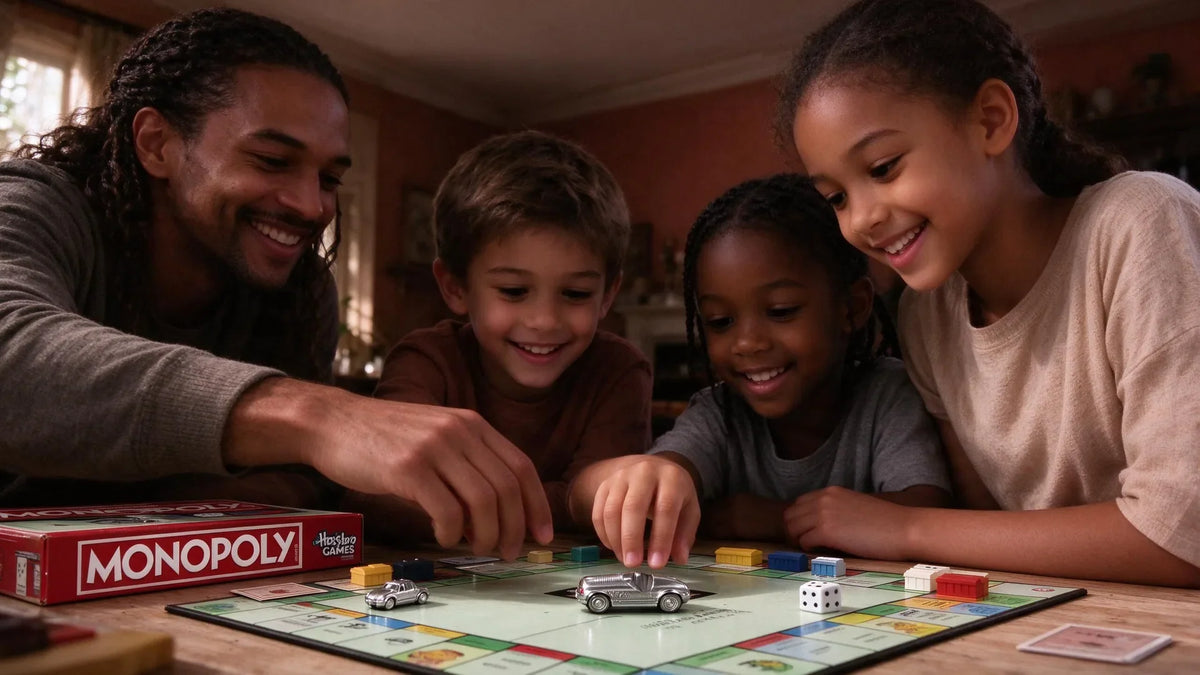
Monopoly is for groups in the mood for buying property, collecting rent, and negotiating. Players gradually compete over who stays in the game; others can drop out after running out of money. That makes it a choice for a longer session rather than short, casual play.
The game is designed for 2-6 players aged 8 and up. This edition includes eight larger metal tokens, including a Scottie dog, a race car, a penguin, and a money bag. Storage space helps organize banknotes, title deeds, houses, and hotels; a winner-tracking sheet is also included. Consider it if classic competition suits you, not a short game.
Wavelength for conversation and shared guessing
In Wavelength, players discuss where on the spectrum to place a clue and together try to estimate the correct spot. It's a game of conversation and shared intuition, not of complex strategic decisions. Setup takes about five seconds, the rules can be learned in roughly a minute according to the source, and the game itself lasts about 30 minutes.
It supports 2-12 or more players aged 14 and up. The package contains 84 Wavelength cards and 42 Advanced cards with additional prompts; the portable format requires no batteries. The age recommendation matters: the game may not be suitable for younger children. And if your group is mainly looking for tactical decision-making, its discussion- and humor-driven style may not appeal.
Scrabble for word building
Scrabble offers the classic crossword game in which players build words and score points for their placement. It is designed for 2-4 players aged 8 and up, and a game lasts an estimated 40 minutes. Team rules and other ways to play let you change the format without losing the word-building core of the game.
This edition includes 100 wooden letter tiles and four wooden racks. The textured board helps keep the tiles in place, and the scoring squares add strategic decisions; the guide includes tips as well as team play. Do keep in mind the limit of 2-4 players, a longer play time than a short game, and the warning that small tiles pose a choking hazard.
CATAN, when you have time for strategy and trading
CATAN combines trading, resource management, building, and strategic decision-making in a game that, according to the source, lasts 60-90 minutes. It is designed for 3-4 players aged 10 and up. Players collect bricks, wood, grain, ore, and sheep to build roads, settlements, and cities and progress toward the goal of 10 victory points.
 AI GENERATED
Modular hexagonal tiles change the layout of the island between games, so the board creates different configurations. The base game is limited to 3-4 players; a 5-6 player expansion is sold separately. Choose CATAN when the group is in the mood for negotiation and decisions that develop throughout the game. If the evening is short or more of you get together, these limitations may make the decision for you.
Key takeaways
- First compare the number of players with the game's limit: Wavelength handles 2-12 or more, Scrabble 2-4, and the base CATAN 3-4.
- If time is short, consider Codenames with an estimated length of about 15 minutes; CATAN requires 60-90 minutes according to the source.
- Choose according to the mood: conversation and guessing are offered by Wavelength, team clues by Codenames, word building by Scrabble, and trading by CATAN.
- For Scrabble, consider the age of 8 and up, the limit of 2-4 players, the estimated 40 minutes, and the risk of choking on small pieces.
Practical tips
- Before opening the box, clarify whether the player count also includes people who may join later; Wavelength lists a range of up to 12 or more.
- Treat estimated times as a comparison aid, not as a guaranteed length of every game.
- If you can't decide between two games, first rule out those whose age recommendation or player count doesn't fit.


