
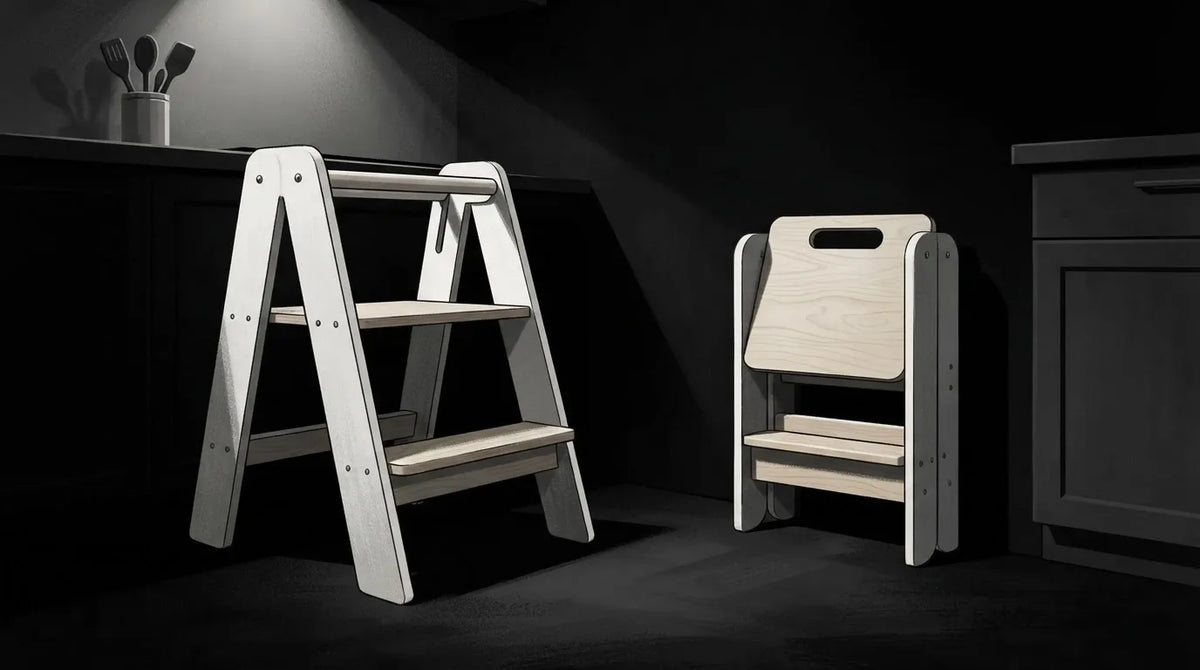
In short: A foldable step stool can help a child get involved in activities at the kitchen counter and, after use, free up the floor if the specific model can be folded. The Family-SCL description mentions this option but does not specify the folded dimensions. Folding flat, as mentioned in the available source, applies to the Little Helper learning tower, not the step stool.
- In a small space, consider not only use at the counter but also whether you need to free up the floor after the activity.
- The Family-SCL description confirms it can be folded, but it does not state its folded dimensions or the exact way to store it.
- Before deciding, verify the folded dimensions and folding instructions if you need them to assess the space.
- Folding flat, the triangular frame, and other design features in the article belong to the Little Helper learning tower, not automatically to the step stool.
Can a step stool help a child get involved in activities at the kitchen counter, and can it be stored away after use so it doesn't get in the way? In a small kitchen, both questions are equally practical. For the Family-SCL model, the available description states that it can be folded and stored, has a compact wooden construction with metal parts, and can complement activities at the sink, in the kitchen, or during crafting. However, the specific dimensions or the method of storage after folding are not mentioned in the available description.
A foldable step stool can help a child get involved in activities at the kitchen counter and, after use, free up the floor if the specific model can be folded. The Family-SCL description mentions this option but does not specify the folded dimensions. Folding flat, as mentioned in the available source, applies to the Little Helper learning tower, not the step stool.
Therefore, it is good to distinguish between what we know about the step stool and what the article describes about another aid—the learning tower. According to the source, it is the Little Helper tower that folds flat. This is not a detail that can be automatically transferred to the foldable step stool.
Why Is Counter Height a Barrier for a Small Child?
In the morning, a child may stand on tiptoes to see what you are preparing on the kitchen counter. If they cannot reach it, it is harder for them to join in everyday family activities. An article about learning towers points out that height is a physical barrier for small children; the source also describes a regular chair as a dangerous substitute and holding a child on one arm while cooking as challenging.

That is why a tool that helps reach a higher work surface can change an everyday situation: the child can see better what is happening and can be part of family activities. However, when choosing a foldable step stool, it is not just about its use at the counter. In a small kitchen, what matters too is what happens to it when it is not in use.
When Does a Foldable Step Stool Make Sense in a Small Kitchen?
A foldable step stool can suit a household that needs to free up floor space after an activity. According to the Family-SCL description, this small step stool can be folded away after use and is suitable for activities at the sink, in the kitchen, or during crafting. This helps assess its role in a household routine, but it does not say how much space it takes up when folded or where it can be stored.
So when should you put it away? When the activity you brought it out for is finished and you need to free up space again. If the space is usually shared by multiple activities or needs to stay clear after use, foldability can be an important criterion. However, before deciding, check how the specific model folds and what its dimensions are when folded.
For Family-SCL, the product description mentions a compact wooden construction with metal parts. However, it does not specify dimensions, folding details, or a specific storage spot. Therefore, do not conclude from the label "compact" that the step stool will fit into a certain cabinet or narrow gap.
What to check when storing a step stool?
Before choosing, compare the product description with how you actually use your kitchen at home. The key is to find out whether the model folds, what its dimensions are when folded, and whether the way it is stored suits you. The available description of the Family-SCL confirms that it can be folded, but it does not provide all these details.
When reading the product details, focus on these questions:
- Does the manufacturer state whether the step stool can be folded?
- Are the dimensions of both the unfolded and folded product available?
- Is it clearly described how the product is stored after use?
- Does the stated use match what you want to use it for at home? This way, you can assess the storage of the step stool without having to guess its features. If the dimensions or folding details are missing, it is worth requesting them or checking them in the current product description before making a decision.
The Little Helper Learning Tower Is a Different Product
The Little Helper learning tower from the external article is a standalone example of a solution for children who want to join in everyday activities. Its frame consists of a classic folding triangular construction, which the source associates with stability. According to the article, the tower can be folded flat so it can be stored away when space is limited. These features describe the tower, not the Family-SCL step stool.

PUPUPULA collaborated on the tower's design with the Swedish design studio Studio Dejawu. Designer Jiang Qian, the studio's founder, focuses on structural design; the collaboration was initiated by Asu, PUPUPULA's lead designer, when the team began developing the learning tower. The goal was to limit unnecessary elements and keep only those with a function.
The tower features an integrated drawing surface on the side panel and a pen holder cut directly into the frame, complemented by magnets. The article also mentions testing of several prototypes focused on frame stability. When the edges of the drawing surface seemed slightly sharp on the first prototypes, the team adjusted and rounded them; they used custom molds for this, even though production was more costly. Neither these safety adjustments nor the structural features can be attributed to the folding step stool.
The source describes the learning tower as a product designed for longer use: once a child outgrows it, it can be passed on to a younger sibling, friends, or another family. This information also pertains to the Little Helper tower, not automatically to another product.
How to Decide Whether the Aid Fits Your Routine
Start with what the child will do with the aid, then consider how often you will need to free up space after use. For the Family-SCL step stool, the available description mentions use at the sink, in the kitchen, and for crafting, as well as the option to fold it. If precise dimensions or the storage method matter to you, you should verify the missing details directly with the specific model.
So the deciding factor is not just whether the child can reach higher. It also matters whether the product fits into your activities and whether its storage matches the space you have available. For the Little Helper learning tower, we know the specific method—folding flat. For the step stool, rely only on its own, verified description.
Can the folding step stool be put away after each use?
That depends on the specific model. The description of the Family-SCL step stool states that it can be folded and stored, but it does not specify the folded dimensions or the exact storage method. So before choosing, check whether the product details match the space you have available at home.
Does the Family-SCL step stool fold flat like the Little Helper learning tower?
The available description of the Family-SCL confirms that the step stool can be folded, but it does not say whether it folds flat. Folding flat is a feature of the Little Helper learning tower described in an external article. These two products should be distinguished, and their design features should not be confused.
Key takeaways
- If space is limited, consider not only use at the counter but also whether you need to free up floor space after the activity is done.
- The Family-SCL description confirms it can be folded, but it does not provide its folded dimensions or the exact way to store it.
- Before deciding, verify the folded dimensions of the product and the folding instructions if you need them to assess the space.
- Folding flat, the triangular frame, and other design features mentioned in the article belong to the Little Helper learning tower, not automatically to the step stool.
Practical tips
- When checking product details, look for separate dimensions for both the unfolded and folded states; a note about a compact design does not replace them.
- Compare the product's stated use with the activities you intend to use it for, such as at the sink, in the kitchen, or during crafting.
- If the description does not mention how the product folds or how much space it takes up when folded, request this information before making a decision.


