
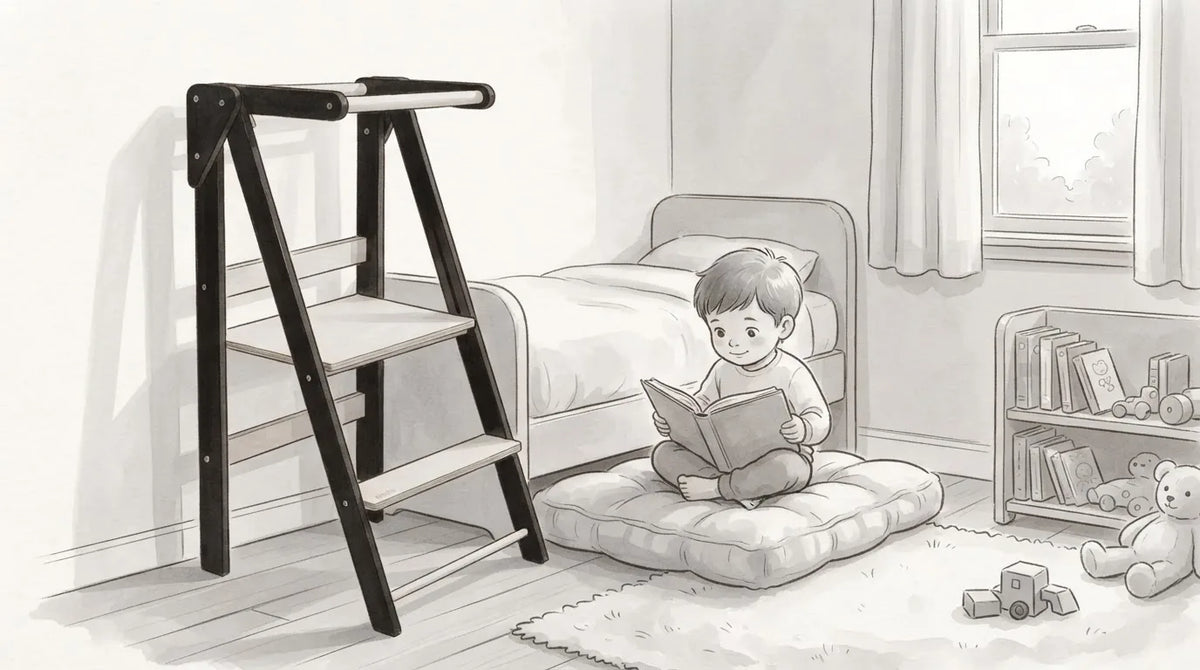
In brief: A modular bed can free up space by changing its configuration to suit the child's needs, rather than by being stored away after use. The Steady Bed can be adjusted from a standard bed through raised solutions to a bunk bed setup; according to the manufacturer, the latter can be split into two separate beds. The source does not provide data on the features of the folding piece.
- With the standard Steady Bed, the side rails are removed gradually: it becomes a day bed and finally a classic bed with a headboard and footboard.
- The low raised configuration has a platform 78 cm from the floor; under the higher bed, there is 140 cm of usable height.
- The classic bunk bed setup measures 1.2 + 1.2 m, with 103.6 cm of clearance under the lower bed; the family version has a 1.2 + 1.5 m setup.
- According to the manufacturer, the bunk bed setup can be split into two separate beds when the room layout changes.
- The source documents the possibilities of the modular bed, not the features of a specific folding piece.
Furniture can save space in two distinct ways: it adapts to the next stage of the child's life, or it is stored away after use. With the Steady Bed modular bed, the first option is documented. The manufacturer describes how one bed transforms from a more enclosed bed into a day bed, a raised bed, or a bunk bed setup. However, the available source does not state the features of a specific folding piece, so they cannot be compared as facts.
A modular bed can free up space by changing its configuration to suit the child's needs, rather than by being stored away after use. The Steady Bed can be adjusted from a standard bed through raised solutions to a bunk bed setup; according to the manufacturer, the latter can be split into two separate beds. The source does not provide data on the features of the folding piece.
When deciding, you can ask three questions: How often will the piece of furniture be used? Does its function change as the child grows or the room layout changes? And if you won't be using it, where will it be stored? The example of a modular bed helps explore the first side of this choice: not storing the piece after use, but changing its configuration according to the family's needs.
Why a modular bed can keep up with changes in the family
When a child outgrows the crib, siblings start sharing a room, or they move into separate rooms, what you need from furniture changes too. A bed can stop fitting a new stage before its materials wear out. The Steady Bed range by Pupupula is designed to be adjusted with extensions and removable side rails instead of being replaced with another piece.
According to the manufacturer, the design is based on months of conversations with parents and observations of children's daily movements in the bedroom. One specific detail is the felt storage box that attaches to the upper bed's railing. A book, a small light, or glasses can thus stay within the child's reach without having to climb out of bed.
This example shows that adaptability is not only about a big change like moving from one bed to a bunk bed. The manufacturer also describes a small bedtime situation that the design addresses with a specific accessory.
How is the bed designed for configuration changes?
The Steady Bed has a modular frame with four side rails and consists of nearly 70 components and more than 350 pieces of structural hardware. The manufacturer states that all four corner posts have symmetrical precision drilling. Therefore, the front and rear posts cannot be mixed up during assembly, and the ladder can be placed on the left or right side, or its position can be changed.

For pieces that change, how they are handled during assembly and reassembly also matters. Symmetrical posts simplify the orientation of parts, and the choice of ladder side allows the setup to be adapted to the room layout. The source describes a specific structural solution; it does not state assembly time or compare it with other beds.
What possibilities do the four configurations of the modular bed offer?
The four configurations change not only the look of the bed, but also how the space in the room is used. It starts with a standard bed with side rails and continues with raised or bunk bed solutions. The manufacturer states that the individual bases and extensions can be adapted to the changing needs of the child and the family.

Standard bed
The basic single bed has four side rails. For a toddler transitioning from a crib, they create a contained space without the look of traditional vertical bars. As the child gains more independence, the left and right side rails can be removed gradually: first, a day bed with three sides is created, and later a classic bed with a headboard and footboard.
Low raised bed
After adding the extension, the platform is 78 cm from the floor; the manufacturer states that the child is approximately at the height of an adult's chest. The space under the bed can be used as a reading nook, a play area, or a storage zone. At the same time, according to the description, the bed remains low enough that making the bed and checking on the child at night are manageable.
Raised bed
The taller extension creates 140 cm of usable height under the platform. The source suggests using this space for a desk, reading nook, storage solution, or a second bed. This configuration is intended for older children and teenagers who need more headroom under the bed.
Bunk bed
For a shared room, the source offers two setups: a classic bunk bed 1.2 + 1.2 m, with 103.6 cm of free height at the lower bed, and a family configuration 1.2 + 1.5 m with a single bed on top and a wider double bed below. The wider lower bed is intended for a parent or caregiver who wants to sleep with the child or care for them during the night.
When the children move to separate rooms, the bunk bed setup can, according to the manufacturer, be split into two separate beds. This is where adaptation to the next stage becomes concrete: the arrangement of the beds changes, not just the place where the furniture is stored.
What the manufacturer states about construction and stability
The description of the Steady Bed highlights construction features designed for stability in elevated and bunk configurations. These are manufacturer claims, not independent verification; the source does not cite a specific safety standard. According to the description, the FSC certification applies to the beech wood, not to the entire bed. The manufacturer lists the following features:
- Corner posts made of solid FSC-certified beech wood measure 6 × 6 cm. The source compares them to standard posts that are less than 4 cm.
- Steel connecting bolts are 1.2 cm thick; the source compares them to a common thickness of 0.8 to 1.0 cm.
- Hidden steel dowels are placed at nine points to distribute load and reinforce the side panels.
- Ladder steps made of solid beech are 2.2 cm thick, with anti-slip grooves and secure screw fastening.
- Cross braces with a thickness of 2 cm run along three sides and, according to the manufacturer, help prevent frame sway. This information helps clarify what the construction consists of. On its own, however, it does not replace information about a specific safety standard, which the source does not provide.
When to choose an adaptable piece and when to consider a foldable one?
The Steady Bed shows how furniture can change function along with the child: side panels are gradually removed, extensions are added, and the bunk configuration can be split into two beds. A foldable piece may be another option if storing the equipment after use is important to you, but the provided materials do not specify its particular features or dimensions.
Therefore, this is not a comparison of two documented products. The decision depends on whether you are addressing repeated changes in function, how often the furniture will be used, and where you would store it after use. For the Steady Bed, the manufacturer describes longer use across various stages of childhood; for a foldable piece, you would need to verify these criteria based on the specific product.
If the child's needs and the room layout change, a modular bed offers a way to modify the configuration itself instead of replacing it with another piece. The benefit of folding may lie in freeing up space after use, but without data on a specific product, it is impossible to say how well it fulfills that need. You can find a description of the Steady Bed's options in the manufacturer's material on the modular bed range.
Can a bed with side rails be turned into a regular bed?
According to the Steady Bed description, on a standard bed the left and right side rails can be gradually removed. First, it becomes a day bed with three sides, and after removing another side rail, a classic bed with a headboard and footboard. These are configuration options stated by the manufacturer for this bed range.
Can the bunk bed be later split into two separate beds?
The manufacturer states that Steady Bed bunk beds can be taken apart into two separate beds when rearranging rooms. This solution may suit a situation where the children no longer share a room. However, the documentation does not specify further technical conditions or the disassembly procedure.
Key takeaways
- With the standard Steady Bed, the side rails are removed gradually: first you get a day bed, and finally a classic bed with a headboard and footboard.
- The low elevated configuration has a platform 78 cm from the floor; under the higher bed there is 140 cm of usable height.
- The classic bunk setup measures 1.2 + 1.2 m, with 103.6 cm of clearance under the lower bed; the family version has a 1.2 + 1.5 m configuration.
- According to the manufacturer, the bunk setup can be split into two separate beds when the room layout changes.
- The source documents the options of the modular bed, not the features of a specific folding piece.
Practical tips
- Before choosing, write down which configurations might suit your future stages: separate sleeping, more space under the bed, or a shared room.
- In the elevated configuration, compare the stated height of the space under the bed with your planned use, such as a desk or a second bed.
- If you are considering a folding product, check its dimensions when folded and where you will store it; these details are not included in the provided description.
- When it comes to safety information, distinguish between structural features stated by the manufacturer and a specific safety standard or independent verification.


