
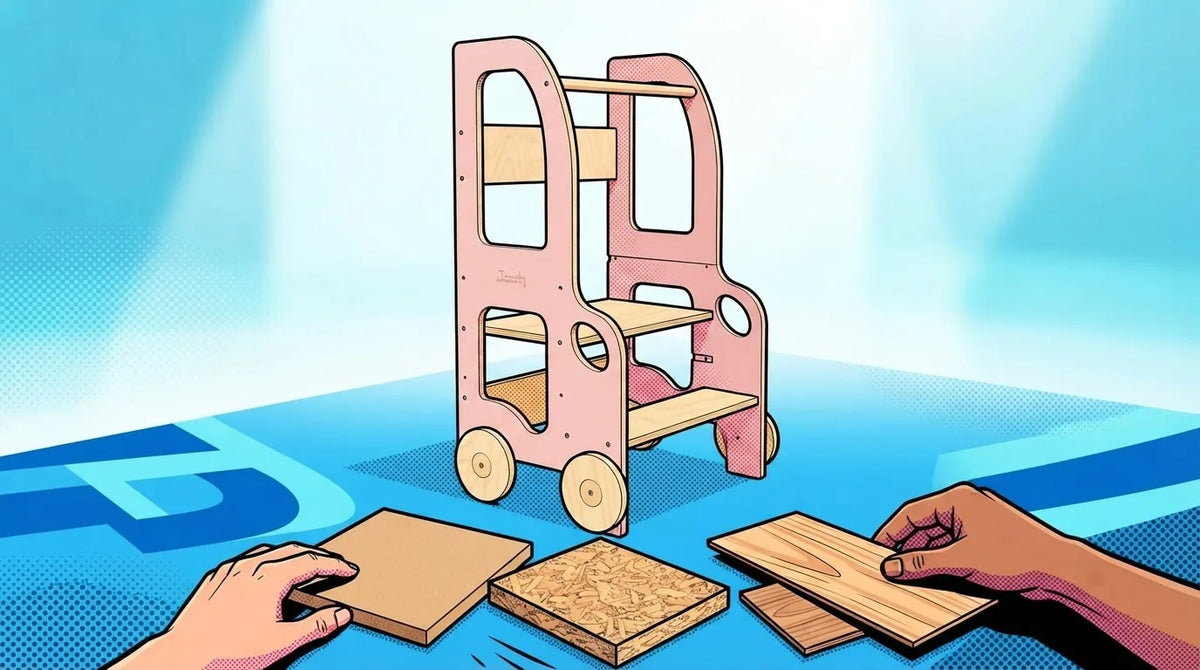
In brief: Judge the material of a kitchen step stool by the role of each part, not by the name of the board. MDF, PB, and plywood have different structures and properties. Therefore, check what the individual parts are made of; the material of a specific step stool cannot be guessed without confirmation.
- MDF is made from fine wood powder with adhesive, resulting in a smooth, dense board suitable even for thin cuts.
- PB, made from larger wood chips or shavings, requires less adhesive compared to MDF, and in the source it is used for stable, wide, and flat parts.
- Plywood, made from solid wood, has cross-laminated layers with perpendicular grain direction; the source attributes strength and flexibility to it.
- For a kitchen step stool, verify the material of individual parts with the seller; the source does not specify the material of a particular step stool.
Judge the material of a kitchen step stool by the role of each part. MDF, PB particle board, and plywood have different structures, and therefore they are associated with different uses. However, from the description, it is not possible to guess what a specific step stool is made of.
Judge the material of a kitchen step stool by the role of each part, not by the name of the board. MDF, PB, and plywood have different structures and properties. Therefore, check what the individual parts are made of; the material of a specific step stool cannot be guessed without confirmation.
What Does the Material of a Kitchen Step Stool Tell You?
First, check whether the description specifies the material of each part or just gives a general product label. It's important to understand the mechanical role of each component, rather than declaring one type of board as the best for every use.

Boards differ in the size of wood particles and the arrangement of layers. This affects whether the material suits a smooth thin panel, a stable flat section, or a solid, shapeable part in the given examples. The source article explains that boards in furniture can differ in appearance and behavior; therefore, it's more meaningful to compare them by function rather than rank them from supposedly best to worst. shop.pupupula.com
MDF: What It's Made From and Where It's Used
MDF is made from fine wood powder mixed with adhesive. The mixture is pressed at high temperature and pressure, resulting in a dense, smooth board that can be cut thin without splitting or fraying at the edges.
In the source, E0 MDF is mentioned for the back panels of storage systems and the shelves of the No. 1 Study Desk. In the described storage system, the back panels create a light enclosed space that prevents dust from entering, while built-in gaps allow ventilation. This is a feature of the given example, not a claim about the kitchen step stool.
Fine powder requires relatively more adhesive during production. The source therefore emphasizes the importance of emission control and mentions the E0 label for the specific material in the described examples. If MDF is mentioned in the step stool's description, check which parts it applies to and what data the manufacturer provides for that particular material.
Particleboard PB: How does it differ from MDF?
Particleboard PB is made from larger wood chips or shavings. Compared to MDF, it requires less glue to bind them together. The orientation of the particles creates a structure intended for stable, wide, and flat components.
The source mentions PB in the constructions of the Cube and Plus storage systems and in the Little House Bed Range. For the material of these examples, it uses the designation F4-Star and associates it with low emissions according to the Japanese standard. This information applies to the mentioned materials and products; it cannot be transferred to the kitchen step stool without specific confirmation.
So with PB, it's not just that the particles are larger than with MDF. The connection between their arrangement and the use of the board for large, flat parts that need to remain stable is also essential. However, it is not a rule that a specific part of each step stool must be made from PB.
Multilayer board: How do its layers relate to its use?
Multilayer board made of solid wood consists of thin layers glued crosswise. The fibers in adjacent layers run perpendicular to each other. The source attributes strength and flexibility to it, which is why, in the given examples, it is used for load-bearing parts and for shaping rounded profiles.
Examples include the Big Eyes Bed frame, the No. 1 Chair, and the Any-way Range. The board is labeled E0, and its edges remain exposed, with a finish of natural white oak veneer. These details also pertain to the specific examples in the source, not to any other product.
How do MDF, PB, and multi-layer board differ?
The following overview links the structure of each board type with the properties and typical use cases mentioned in the source. This is not a ranking of quality, but rather different materials used for different purposes.
| Board type | Structure and properties | Use cases mentioned in the source |
|---|---|---|
| MDF | Fine wood powder with adhesive, pressed at high temperature and pressure; a smooth, dense board suitable even for thin cuts without frayed edges. | Back panels of storage systems and shelves of the No. 1 Study Desk; the source specifies E0 MDF. |
| PB | Larger wood chips or shavings; compared to MDF, less adhesive and a structure intended for stable, wide, and flat parts. | Cube and Plus storage systems and the Little House Bed Range; the source examples mention F4-Star. |
| Multi-layer solid wood board | Thin layers glued crosswise with perpendicular grain direction; strong and flexible, suitable for load-bearing parts and rounded profiles. | Frame of the Big Eyes Bed, the No. 1 Chair, and the Any-way Range; the board is marked as E0 and the edges have a natural white oak veneer finish. |
What to check with the seller of a kitchen step stool?
The material data for the entire product may not explain what its individual parts are made of. If the description does not provide this information, ask the seller for clarification. This gives you a basis for understanding the construction without having to guess the material or its properties. You can ask:
- What material are the individual parts of the step stool made of?
- Does the material differ between parts that have different structural roles?
- If the description mentions the E0 or F4-Star designation, which material and part does it apply to? The source does not specify what material the particular kitchen step stool in the offer is made of. Therefore, the designations and furniture examples given for MDF, PB, or multi-layer board are not a confirmation of the step stool's properties.
What does it mean to choose a board based on the part's role?
It means reading material data in relation to what a specific part of the construction is supposed to do. The fine structure of MDF, the larger particles of PB, and the cross-laminated layers have different properties and are associated with different use cases in the source. Therefore, the board name alone is not enough to assess the entire product.
Can I determine the material of the step stool from the MDF or PB label?
No. The label names the type of board, but it does not confirm that the manufacturer used it for a specific kitchen step stool. Find out which parts the information applies to, or verify it with the seller.
When reading the description, focus on the material of each part and its function. The properties of the board should match the mechanical role of the specific part; however, without manufacturer data, you cannot attribute the material or its properties to a particular step stool.
Key takeaways
- MDF is made from fine wood powder with adhesive, resulting in a smooth, dense board suitable even for thin cuts.
- PB, made from larger wood chips or shavings, requires less adhesive than MDF and is used in the source for stable, wide, and flat parts.
- Plywood from solid wood has cross-laminated layers with perpendicular grain direction; the source attributes strength and flexibility to it.
- For a kitchen step stool, verify the material of each part with the seller; the source does not specify the material of a particular step stool.
Practical tips
- If the description only mentions a general material, ask the seller what each part is made of.
- For E0 or F4-Star labels, verify which material and example they apply to.
- Do not transfer board properties described for other furniture to a specific step stool without confirmation.


