
In brief: When choosing indoor activities for a rainy day, consider the available space and whether your child prefers calmer play or physical movement. Personal examples include a reading tent, Magna-Tiles, creative kits, rotated Lovevery toys, and a Pikler triangle.
- The tent served a four-year-old for shared reading and as a quiet retreat from a younger brother; after it got damaged, the family replaced it with a Djeco tent.
- The family owns original Magna-Tiles pieces, but the author mentions Rail Racers only as a desired example.
- Based on personal experience, the Galt foil craft kit was easy to use and involved minimal mess.
- The author didn't manage regular toy rotation, but stashed favorite toys from Lovevery sets helped when ideas ran out.
- The Pikler triangle with slide was mainly used by the active younger child on days without a park visit.
When choosing indoor activities for children on rainy days, you can base your picks on the space you have and whether your child is currently seeking calmer play or physical activity. In one mother's personal experience, ideas range from reading in a tent to climbing on a Pikler triangle.
When selecting rainy-day activities at home, consider the available space and whether your child leans toward quieter play or movement. Personal examples include a reading tent, Magna-Tiles, creative kits, rotated Lovevery toys, and a Pikler triangle.
You know that feeling when heading outside with kids sounds exhausting, but a whole day at home can feel even longer? In a piece for The Guardian, the author writes that before becoming a mother she had no idea how complicated it could be to get kids out the door (The Guardian). After four and a half years of parenting two young children, she adds that staying home can be even more challenging than leaving the house (The Guardian). Outdoors, children find play inspiration even in ordinary situations. When going out isn't possible, a parent has to figure out how to fill the time.
The following breakdown by calmer versus more active play and available space is the editorial way to make sense of the ideas. The author doesn't present her choices as a universal system or a one-size-fits-all guide. These are her specific experiences—including what didn't work for her.
How to choose activities for kids at home based on space and energy?
If you have room for quieter play, you could try a reading tent or a creative set. When your child needs more movement, you'll find a Pikler triangle in the personal selection. This breakdown helps narrow down the options, but it's not a rule or a plan that the author describes as guaranteed to work.

What does a reading tent offer, including a moment of calm?
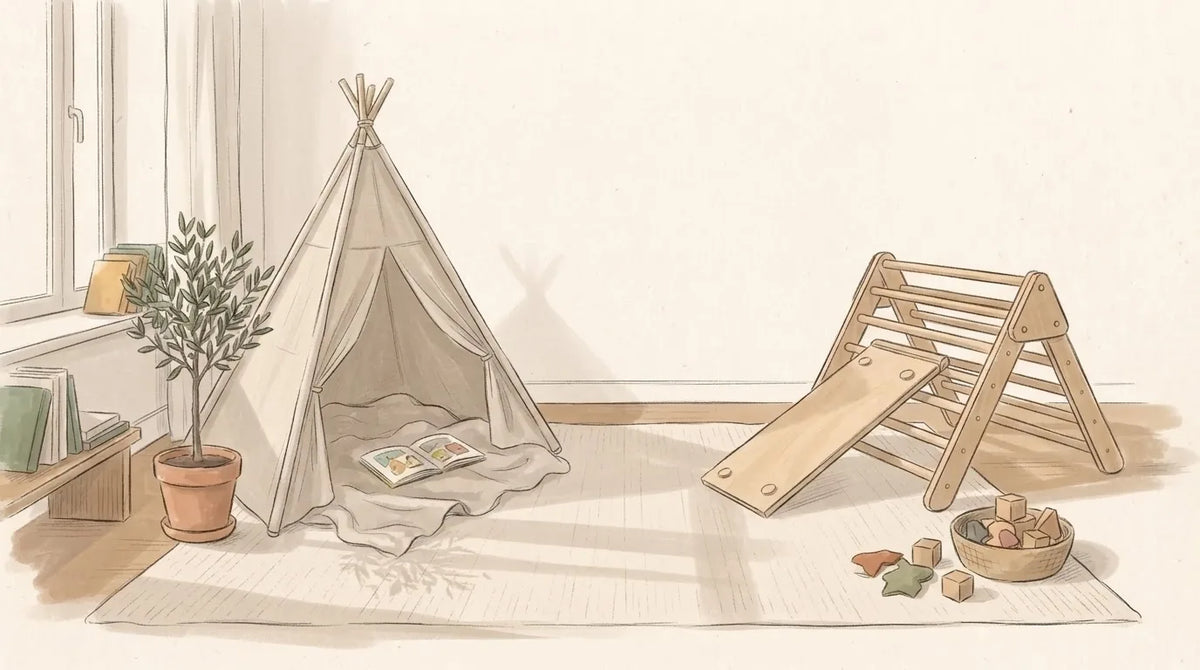
In the family, the tent became a favorite spot for reading together and for moments when the four-year-old needed a break from the younger brother. The author initially doubted whether they needed the tent and was bothered by its size. However, the kids grew to love it. The original tent broke after heavy use, and the family replaced it with a Djeco tent.
In this experience, the tent wasn't just a place to play. It served for cozy reading and also gave the older child some time away from the younger sibling. If you have a spot to place a tent, it could be one of the calmer options for a day when you're staying home. However, the author describes what worked in her family, not a universal outcome.
What do the author's experiences with Magna-Tiles say?
The family has original Magna-Tiles pieces, but not the Rail Racers set. She mentions it as a desired example that she thinks her kids would enjoy. Regarding the pieces themselves, she describes her own experience with their durability, as well as friends' experiences.
According to her, kids and parents alike love Magna-Tiles, and playing with them engages even older children. The original pieces in their household held up well even during the period when the toddler was throwing them. Friends who had cheaper imitations, according to the author, mentioned a difference in durability. So it's useful to distinguish what she tried at home from what she cites as acquaintances' experience: Rail Racers falls into the latter, desired category.
Can a toy car with a steering wheel entertain, even at the cost of noise?
According to the author, the gifted toy car with a steering wheel was a hit with all the children who came to the household. It has a screen with a moving road, plays songs, and can also be pushed like a regular toy car. However, the author describes it as noisy and a big piece of plastic.
The road image on the screen moves as you turn the steering wheel. Children can play at driving or simply push the car along the floor. At the same time, its songs are loud, which the author explicitly notes. It's an example that surprised her with its popularity among the children around her, but it's not without reservations.
Which creative sets does the author mention?
Among the specific creative options, she mentions the Djeco Animal Houses set and the Galt foil art set. For foil art, she appreciates that it's easy to use and leaves minimal mess.
The art supplies in the household were a mix of items collected for various occasions—including tools that mom bought for herself, used once, and put away. Djeco Animal Houses is a specific example she lists; the Galt foil set, in turn, offered a crafting activity where she didn't have to deal with a big mess. If you're looking for calmer ideas for a rainy day, these are two options from her personal selection.
How did stashed-away toys help when ideas ran out?
The author didn't manage to rotate toys regularly as originally planned. However, she found it helpful to set aside some favorite toys from the Lovevery sets and bring them out on days when they stayed home and she ran out of ideas.
According to the author, Lovevery sets arrive every two to three months and focus on the child's current age. She describes them as high-quality, often wooden, but not cheap. Over the years, the family bought one or two sets or received them from family.
The key point is the difference between what the author imagined and what she managed to do in everyday parenting. She didn't put away and bring back all toys on a regular schedule. However, she kept a few favorite items from the sets for later, and those helped her when she ran out of ideas on a day at home.
What does a Pikler triangle offer on a day without the park?
The Pikler triangle was given to the oldest child as a toddler, but later it was mainly used by the very active younger child. On days without a park visit, they climbed on it and slid down the attached slide.
The author initially doubted whether the triangle would be useful for the family. She appreciated it more with the younger child, whom she describes as extremely active. She also mentions accessories, including a slide, which allowed the child to climb and slide indoors. In her selection, the triangle represents a more active option for times when going to the park wasn't possible.
What to do with kids at home when ideas run out?
If you struggle to rotate all toys regularly, the author's personal experience shows a simpler fallback option: set aside a few favorite items and return to them on a day when you're staying home. That's exactly how some toys from the Lovevery sets helped her.

For a calmer moment, you can choose from her examples a reading tent or a creative set. If the child needs more movement, her family used the Pikler triangle with a slide. This isn't a mandatory activity schedule or a claim that one idea works for everyone. It's a personal selection that can help you decide what to try based on space and the child's current energy.
Key takeaways
- The tent served a four-year-old for shared reading and for a break from a younger brother; the family replaced it with a Djeco tent after it got damaged.
- The family has original Magna-Tiles pieces, but the author mentions Rail Racers only as a desired example.
- The Galt foil set was, according to personal experience, easy to use and involved minimal mess.
- The author didn't manage regular toy rotation, but set-aside favorite toys from the Lovevery sets helped her when ideas ran out.
- The Pikler triangle with a slide was mainly used by an active younger child on days without a park visit.
Practical tips
- As an editorial guide, notice whether the child is currently seeking calmer play or movement; this isn't a plan the author describes as universal.
- From the source's calmer examples, you might consider a reading tent or the Djeco Animal Houses and Galt creative sets.
- If you're running out of ideas, the author's personal experience offers the option of setting aside some favorite toys from the Lovevery sets for days at home.


